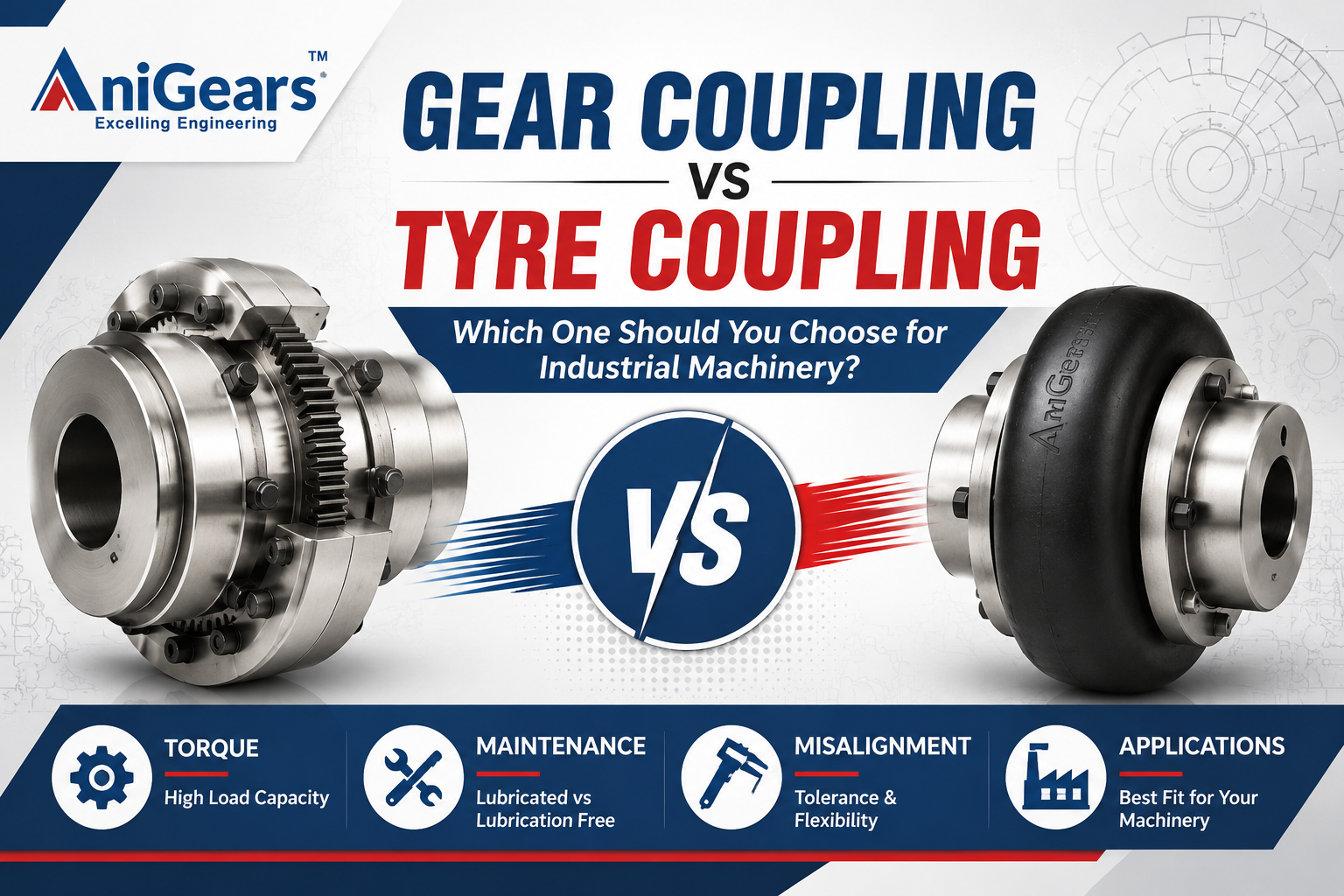
Gear Coupling vs Tyre Coupling: Which One Should You Choose for Industrial Machinery?
A maintenance engineer at a cement plant once told us he'd replaced the same coupling four times in two years. The machine kept vibrating loose, bolts kept shearing, and nobody had asked why. Turned out the plant had installed a coupling built for smooth, low-shock pump duty on a crusher drive that slams with every load cycle. Wrong coupling, wrong application, four failures. That's the whole reason this article exists.
Gear couplings and tyre couplings both connect two rotating shafts and both allow for some misalignment. Past that, they don't behave the same way, and picking the wrong one shows up as downtime, bearing damage, unplanned vibration, and a maintenance bill nobody budgeted for. This guide walks through how each one works, where each one earns its keep, and how to tell which your machine actually needs.
Why Choosing the Right Coupling Matters
A coupling looks like a small, forgettable part of a drivetrain until it isn't. The wrong choice doesn't usually fail on day one — it fails slowly, and the costs stack up in places that don't get traced back to the coupling.
- Downtime: an unplanned coupling failure on a conveyor or crusher can stop an entire line, not just one machine.
- Bearing damage: a coupling that can't absorb the misalignment it's actually seeing transfers that load straight into the motor and gearbox bearings.
- Vibration: mismatched couplings run rough, and rough running loosens foundation bolts, cracks welds, and wears out seals faster than the duty cycle should allow.
- Maintenance cost: a coupling that needs weekly lubrication on a hard-to-reach shaft turns into a recurring labor cost that a different coupling type would have avoided.
- Energy loss: a coupling running misaligned or under-rated doesn't just wear out — it wastes power getting the torque through in the first place.
None of this means one coupling type is universally "better." It means the right choice depends on torque, shock load, alignment tolerance, and how the machine actually runs day to day — which is what the rest of this article is about.
What Is a Gear Coupling?
A gear coupling connects two shafts through a pair of hubs with external, crowned gear teeth that mesh with an internal-tooth sleeve. The crown on the teeth — a slight barrel shape rather than a straight tooth face — is what lets the coupling flex and keep transmitting torque even when the two shafts aren't perfectly in line.
Because the load passes through a full set of meshing teeth rather than a rubber element, gear couplings carry high torque in a compact size. That meshing also needs lubrication (grease or oil, depending on the design) to keep the teeth from wearing prematurely, which is the trade-off for the extra torque capacity.
Where gear couplings tend to show up: steel plants, rolling mills, mining equipment, cement plants, heavy conveyors, paper mills, marine drivetrains, and high-torque gearboxes — anywhere the load is heavy and fairly steady rather than sharp and shock-driven.
AniGears manufactures gear couplings in two product lines — the AG Series Gear Couplings for standard industrial drives and the EA Series Gear Couplings for higher-torque, heavy-duty applications.
What Is a Tyre Coupling?
A tyre coupling uses a flexible rubber (or polyurethane) element — shaped like a tyre in cross-section — clamped between two hubs, one on each shaft. There's no metal-to-metal contact transmitting the torque; it goes through the rubber, which is what gives this design its two defining traits: it doesn't need lubrication, and it absorbs shock and vibration instead of transmitting it.
That flexibility is also what limits it. A tyre coupling can't carry the torque a similarly sized gear coupling can, and it has less tolerance for angular and parallel misalignment. What it does well is protect the connected equipment from shock loads and vibration, and it's simple to service — most designs let you pull the rubber element and replace it without moving the motor or the driven machine.
Typical applications: pumps, compressors, cooling towers, HVAC systems, blowers, fans, water treatment equipment, and packaging machinery — generally lighter, smoother-running loads where vibration isolation matters more than raw torque capacity.
See AniGears' full range of Tyre Couplings for dimensions and torque ratings by size.
Gear Coupling vs Tyre Coupling: Side-by-Side Comparison
Here's how the two stack up across the factors that actually decide which one belongs on your machine.
| Factor | Gear Coupling | Tyre Coupling |
|---|---|---|
| Torque Capacity | High — best for heavy, steady loads | Moderate — suited to lighter drives |
| Misalignment Tolerance | Good, but tighter than tyre | Higher — absorbs more angular/parallel offset |
| Shock Absorption | Limited — rigid tooth engagement | Strong — rubber element cushions shock |
| Lubrication | Required (grease or oil) | None required |
| Maintenance | Periodic lube checks, seal and tooth inspection | Visual rubber inspection, bolt torque checks |
| Speed Range | Suited to high-speed drives | Best at low to moderate speeds |
| Temperature Tolerance | Wide, limited mainly by lubricant | Limited by rubber compound rating |
| Relative Cost | Higher upfront, higher running cost | Lower upfront, lower running cost |
| Installation | Needs closer alignment at setup | More forgiving during installation |
| Service Life | Long, if lubrication is maintained | Depends on rubber element wear |
| Typical Industries | Steel, cement, mining, paper, marine | Pumps, HVAC, compressors, water treatment |
| Downtime for Replacement | Higher — sleeve and teeth need access | Lower — element often replaces in place |
| Noise | Can be noisier under load | Quieter, rubber dampens noise |
| Repair Time | Longer — regreasing and reassembly | Shorter — bolt-in element swap |
When Should You Choose a Gear Coupling?
Reach for a gear coupling when the drive is carrying heavy, fairly constant torque and the shock loading is manageable. That covers most of heavy industry:
- Steel plants and rolling mills
- Mining equipment
- Cement plants
- Heavy conveyor drives
- Paper mills
- Marine propulsion and auxiliary drives
- High-torque gearbox connections
When Is a Tyre Coupling the Better Fit?
A tyre coupling earns its place when the priority is vibration isolation, easy maintenance, and moderate torque rather than raw strength:
- Pumps
- Compressors
- Cooling towers
- HVAC systems
- Blowers and fans
- Water treatment equipment
- Packaging machinery
How Misalignment Affects Coupling Life
Every coupling is rated to handle some misalignment — but not unlimited misalignment, and not all types equally. Three kinds show up in the field:
Angular misalignment
The two shaft centerlines meet at an angle instead of running parallel. Left unchecked, this concentrates load on one side of the coupling and accelerates wear there specifically.
Parallel misalignment
The shafts run parallel to each other but are offset side to side. This bends the coupling slightly with every rotation, which is a fatigue load — it adds up cycle by cycle rather than failing all at once.
Axial misalignment
The shafts are correctly aligned radially but have shifted along their own axis — often from thermal growth as a motor or gearbox heats up during operation. Couplings need enough axial float built in to absorb this without binding.
Ignore any of these for long enough and the symptoms are the same regardless of which type of misalignment caused them: bearing wear, seal leaks, and, eventually, coupling failure. A coupling rated for more misalignment buys forgiveness — it doesn't fix a bad alignment job, but it survives one for longer.
Maintenance Comparison
- Check and top up lubrication on the schedule the manufacturer specifies
- Inspect seals for grease leakage, which is usually the first sign of wear
- Check tooth wear during scheduled shutdowns — worn teeth show up as increased backlash
- Inspect the rubber element for cracking, hardening, or chunking
- Check and re-torque mounting bolts periodically, since vibration can loosen them
- Replace the tyre element once wear is visible — no lubrication routine to manage
Gear Coupling
Tyre Coupling
In practice, gear couplings ask for a maintenance schedule you have to actually follow. Tyre couplings ask for less routine attention but need a visual check before the rubber element degrades to the point of failure.
Cost Comparison
Sticker price is only one part of what a coupling costs over its working life. Five categories are worth weighing against each other, without pinning exact numbers on any of them since they vary by size, torque rating, and supplier:
- Initial cost: tyre couplings are generally the cheaper purchase at equivalent shaft sizes; gear couplings cost more for the torque capacity they carry.
- Operating cost: gear couplings need ongoing lubricant supply and the labor to apply it; tyre couplings have effectively none.
- Maintenance cost: inspection and regreasing labor adds up over a gear coupling's life; a tyre coupling's main maintenance cost is the eventual rubber element replacement.
- Downtime cost: this is where it gets application-specific: a gear coupling failure on a production-critical drive can be far more expensive in lost output than the part itself.
- Replacement cost: tyre elements are usually quick, bolt-in swaps; gear coupling rebuilds take longer and often need the shafts pulled apart further.
The honest answer to "which is cheaper" is: it depends on which of these five costs you're weighing most. A tyre coupling on a pump is cheaper end to end. A gear coupling on a rolling mill drive isn't a cost decision at all — nothing else in that torque range does the job.
Which Industries Prefer Which Coupling?
| Industry | Recommended Coupling |
|---|---|
| Steel | Gear |
| Cement | Gear |
| Sugar | Gear |
| Mining | Gear |
| Water Pumping | Tyre |
| HVAC | Tyre |
| Food Processing | Tyre |
| Compressors | Tyre |
| Textile | Depends on drive torque and speed |
| Paper | Both, depending on the specific drive stage |
These are starting points, not rules. Within a single steel plant, for example, a heavy mill drive will run a gear coupling while an auxiliary pump on the same site runs a tyre coupling. The industry tells you what's typical; the specific drive tells you what's correct.
Common Mistakes While Selecting Couplings
- Sizing for average torque instead of peak torque, including startup and shock loads
- Ignoring the actual operating RPM and picking a coupling rated for a different speed range
- Not matching the coupling bore to the shaft size and keyway precisely
- Installing with poor alignment and assuming the coupling will "absorb" the difference indefinitely
- Ignoring the operating environment — dust, moisture, or high temperature all affect coupling choice
- Using the wrong lubricant, or the right lubricant on the wrong schedule
- Underestimating shock load in applications with frequent starts, stops, or jamming (crushers, mills)
- Buying on price alone, without checking torque rating and service factor against the actual application
How AniGears Helps You Choose
We've been building couplings since 2007, when the company operated as Transpower before becoming AniGears in 2023. In that time the question we get asked most isn't "which coupling is better" — it's "which coupling is right for this machine," and that answer depends on torque, speed, misalignment, and environment specific to that drive.
A few things that shape how we work with customers:
- Engineering support during selection — we look at your actual load and duty cycle rather than just matching a shaft diameter
- ISO 9001:2015 certified manufacturing, with NABL-accredited lab testing on our products
- Custom coupling designs for non-standard shaft sizes, bores, and torque requirements
- Application guidance for industries including steel, cement, power, mining, paper, and heavy engineering
- Consistent delivery timelines, so a coupling failure doesn't turn into extended downtime while you wait on a replacement
If your application sits between the two — moderate torque with some shock loading, for example — it's worth looking at our AB Series Pin Bush Couplings or flexible pin bush couplings, which sit between rigid gear couplings and pure tyre couplings on torque and shock tolerance.
Frequently Asked Questions
Talk to AniGears About Your Application
If you're still not sure which coupling fits your drive, send us the torque, speed, shaft size, and a description of the load — including whether it's steady or shock-driven. We'll size it against our AG, EA, and tyre coupling ranges and tell you straight if one of our standard products fits or if it needs a custom design.