What Is a Tyre Coupling?
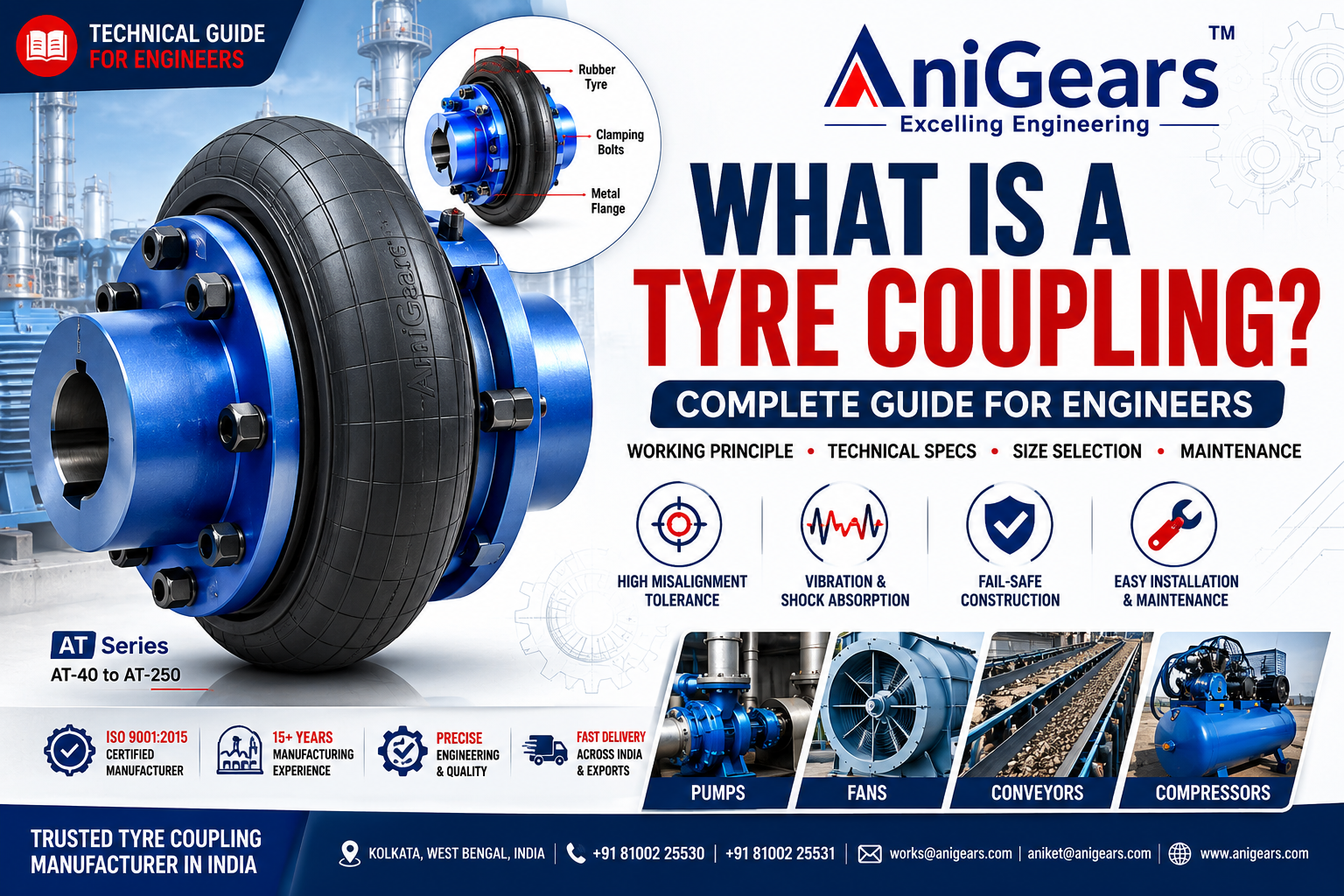
A tyre coupling is a torsionally elastic, flexible shaft coupling designed to transmit torque between two shafts while simultaneously accommodating angular, parallel, and axial misalignments.
The defining component is its cord-reinforced rubber tyre element — a doughnut-shaped flexible ring, structurally similar to a vehicle tyre in cross-section, clamped between two precision-machined metallic flanges. When the driving shaft rotates, torque is transmitted through the rubber element’s elasticity, which also dampens vibration and absorbs shock loads in the process.
This makes tyre couplings fundamentally different from rigid couplings, which transfer torque with no flex, or from jaw couplings, which use a star-shaped elastomeric spider. The full-tyre construction offers higher misalignment tolerance and superior damping compared to most other flexible coupling types.
If you work in industrial maintenance, plant engineering, or procurement, you have likely come across the term "tyre coupling." But what exactly is a tyre coupling, how does it work, and when should you choose it over other flexible coupling types? This guide answers all of that — with accurate technical details drawn from our manufacturing experience at AniGears.
How Does a Tyre Coupling Work?
The working principle is straightforward:
- Two flanges are mounted and keyed onto their respective shafts.
- The rubber tyre element is fitted radially over both flanges, with its beads seated in retaining grooves on each flange.
- Clamping bolts on each flange hold the tyre securely in place.
- When the drive shaft turns, the rubber element flexes and transmits torque to the driven shaft while absorbing any misalignment between them.
Because the tyre is fitted radially rather than axially it can be removed and replaced without moving or unbolting the connected equipment. This “radial fitment design” is a major practical advantage in plant environments where downtime is costly.
One additional safety feature: even if the rubber element suffers fatigue or damage, the interlocking geometry of the flanges allows temporary torque transmission until a planned replacement can be made. This is what is meant by “fail-safe construction.”
Key Technical Specifications
AniGears manufactures tyre couplings in sizes AT-40 through AT-250. Here is a summary of the key parameters across the range:
| Parameter | Range (AT-40 to AT-250) |
|---|---|
| Maximum Bore | 30 mm (AT-40) to 190 mm (AT-250) |
| Maximum Speed | 4,500 RPM (AT-40) to 1,000 RPM (AT-250) |
| Nominal Torque | 21 Nm (AT-40) to 12,606 Nm (AT-250) |
| Maximum Torque | 64 Nm (AT-40) to 42,740 Nm (AT-250) |
| Max Parallel Misalignment | 1.1 mm (AT-40) to 6.6 mm (AT-250) |
| End Float (±) | 1.3 mm (AT-40) to 8.2 mm (AT-250) |
A few points worth noting for engineers selecting a size:
- Speed and torque have an inverse relationship — larger sizes handle higher torques but operate at lower maximum speeds. An AT-250 handles up to 42,740 Nm but is rated to only 1,000 RPM.
- Misalignment tolerance increases with size — the AT-250 accommodates up to 6.6 mm of parallel misalignment vs. 1.1 mm for the AT-40.
- The Coupling Rating @100 RPM in the full dimension table gives transmitted power in kW at 100 RPM — use this with your actual speed to compute power handling at your operating conditions.
How to Select the Right Tyre Coupling Size — 5 Steps
AniGears recommends the following selection procedure. For any assistance, our engineering team is available via our contact page.
- Step 1 — Determine the Service Factor (SF)
The service factor accounts for the nature of the load. Smooth, steady loads may use SF = 1.0. Cyclic, reversing, or shock-loaded drives (crushers, conveyors, compressors) typically require SF = 1.5 to 2.5. - Step 2 — Calculate Design Power (Pₑ)
Design Power = Rated Motor Power (kW) × Service Factor - Step 3 — Select Coupling Size
Using the Design Power and operating speed, identify the coupling size whose Coupling Rating at your speed equals or exceeds Pₑ. - Step 4 — Verify Bore Range
Confirm that the maximum bore of the selected coupling can accommodate both shaft diameters. - Step 5 — Confirm Misalignment and Speed Limits
Check that the actual shaft misalignment and operating speed are within the listed limits for the selected size.
Where Are Tyre Couplings Used?
Tyre couplings are the coupling of choice in applications with cyclic, variable, or reversing torques, or wherever vibration reduction is a design priority. Common applications include:
- Centrifugal pumps and water pumps
- Industrial fans and blowers
- Air and gas compressors
- Belt and screw conveyors
- Mixers and agitators
- Crushers and screening equipment
They are widely deployed across cement plants, steel mills, power generation facilities, water treatment plants, and general industrial machinery.
Tyre Coupling vs. Other Flexible Couplings
Tyre couplings are not always the right choice. Here is a quick comparison:
| Feature | Tyre Coupling | Pin Bush Coupling | Gear Coupling |
|---|---|---|---|
| Misalignment Tolerance | High (all three types) | Moderate | Moderate (angular mainly) |
| Vibration Damping | Excellent | Good | Low |
| Lubrication Required | No | No | Yes (Grease) |
| Torque Capacity | Medium–High | Medium | High–Very High |
| Element Replacement | Without Disturbing Equipment | Requires Disassembly | Requires Disassembly |
| Best For | Pumps, Fans, Compressors | General Industrial Drives | Heavy-Duty, High-Torque Drives |
For applications requiring maximum torque density with minimal vibration concern, a gear coupling may be more appropriate. For general-purpose industrial drives, pin bush couplings offer a cost-effective solution. For shock-heavy or vibration-sensitive applications, the tyre coupling is typically the best fit.
Why Choose AniGears as Your Tyre Coupling Manufacturer in India?
AniGears Engineering Solutions has been manufacturing industrial couplings since 2007 (originally as Transpower) and has built a track record across the steel, cement, power, mining, paper, and heavy engineering sectors.
Our tyre couplings are manufactured under ISO 9001:2015 certified quality systems, with dimensional accuracy checked at each stage of production. Every coupling is quality-inspected before dispatch for bore accuracy, tyre seating, and balance.
We supply the full AT-40 to AT-250 range from our facility in Vadodara, Gujarat, with fast delivery across India and export availability internationally. Custom bore sizes and flanges are available on request.
Download our full product catalogue for complete dimensional data, or request a quote directly from our team.
You can also explore our complete range of industrial couplings and Ani-Flex Taper Lock V-Pulleys for your power transmission requirements.