Gear Coupling vs Pin Bush Coupling (AG Series vs AB Series): Which One Actually Fits Your Drive?
If you're specifying a coupling for a new drive or replacing one that just failed on you, you'll eventually land on this exact question: gear coupling or pin bush coupling? Both are flexible couplings. Both connect a driving shaft to a driven shaft and forgive a certain amount of misalignment along the way. But they solve that problem in completely different ways, and picking the wrong one tends to show up months later—as premature wear, vibration you can't quite explain, or a coupling that simply wasn't built for the torque you're actually running.
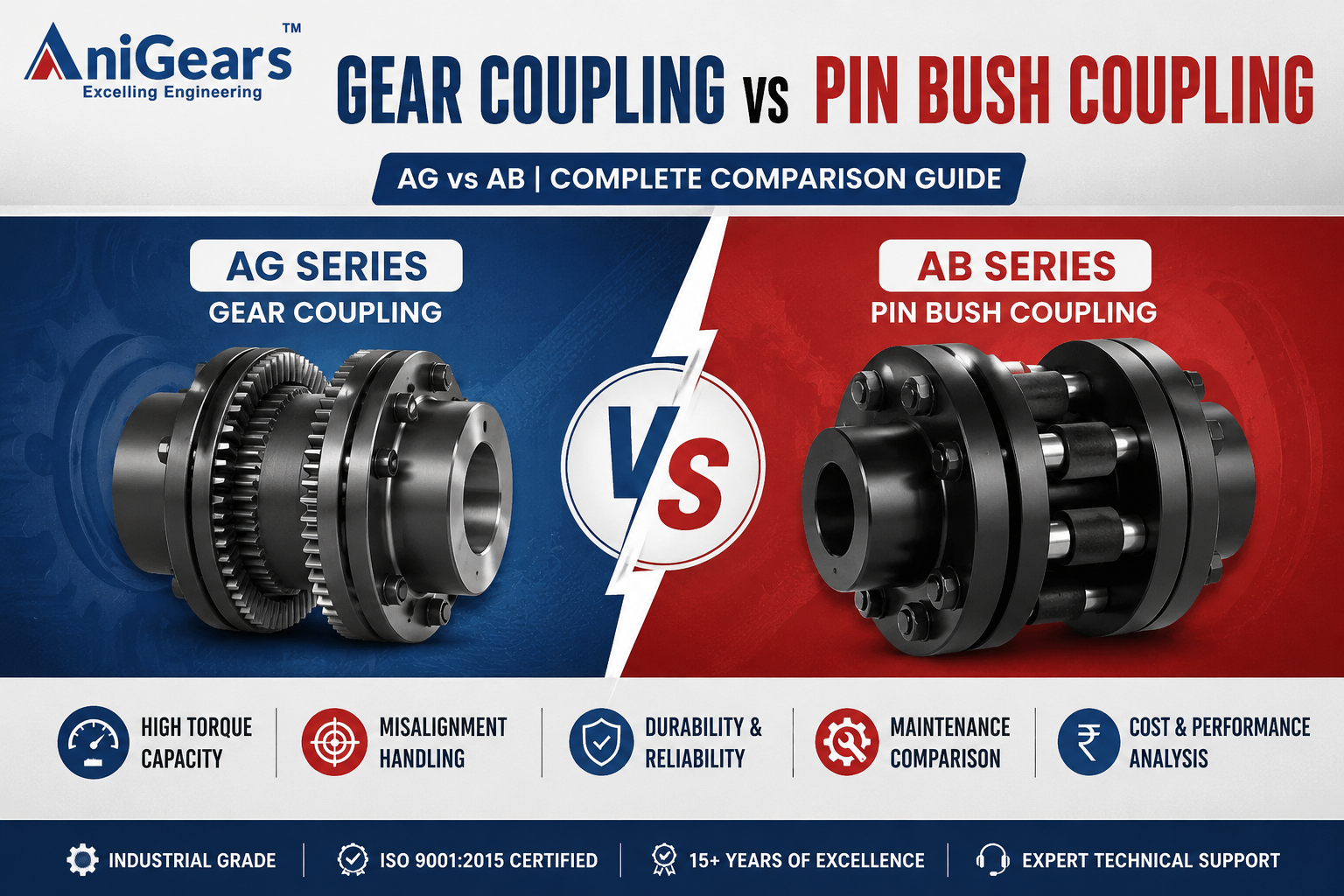
We manufacture both at AniGears, so this isn't a hypothetical comparison. The AG Series is our gear coupling line, the one you reach for when torque and speed matter more than anything else. The AB Series is our pin bush coupling line, built around barrel-shaped rubber bushes that soak up shock and vibration instead of fighting it. Here's how they actually compare, and which one makes sense for what kind of drive.
What Is an AG Series Gear Coupling?
The AG Series is a full gear coupling— what's sometimes called an FGC type. Torque moves through accurately machined, hardened, and crowned gear teeth on the hubs, which engage with internal teeth cut into the sleeves. That crowning matters: it spreads the load evenly across the tooth face instead of letting it concentrate at one edge when the shafts are slightly out of line.
It comes in Short Teeth (ST) and Long Teeth (LT) configurations. ST gives you more angular flexibility, which helps if your shaft alignment tends to drift. LT gives you more torque capacity and a larger contact area, at the cost of a bit of misalignment tolerance. Sizes run from AG-101 (1,100 Nm at 100 rpm) all the way to AG-119 (1,470,000 Nm), so the range covers everything from small auxiliary drives to genuinely heavy industrial machinery. Every coupling is CED-coated for corrosion protection.
The catch is lubrication. Because torque travels through metal teeth, the mesh needs EP2 grease, filled to about 75% of the coupling cavity, and that grease needs checking and topping up periodically. In exchange, you get a connection that's torsionally rigid — almost no wind-up under load — and rated for genuinely high speeds, with the smaller sizes running past 6,000 rpm.
What Is an AB Series Pin Bush Coupling?
The AB Series works on a completely different principle. Instead of gear teeth, it uses steel pins fitted with barrel-shaped rubber bushes, sitting between two coupling halves. When the driving shaft turns, torque passes through the pin and then through the elastomer bush before it reaches the driven side. That rubber layer is doing real work — it's what gives the AB Series its shock absorption and vibration damping.
The barrel shape is the detail that separates it from a standard cylindrical bush coupling. It spreads stress more evenly across the elastomer, which is why AB Series couplings tolerate more misalignment than the cylindrical-bush AP Series — up to about 3° angular and 3 mm parallel, against 2° and 2 mm on the AP. Sizes span AB-105-3 (95 Nm) up to AB-2000-26 (over 1,300,000 Nm), so like the AG Series, it covers small drives right up to heavy industrial ones.
No lubrication is needed, which simplifies maintenance and avoids the contamination risk that comes with grease in dusty or wet environments. And if a bush ever wears out or fails, the steel pins can still make metallic contact — so the drive doesn't stop dead, it just keeps limping along on reduced capacity until you can service it.
What Is an AG Series Gear Coupling?
The AG Series is a full gear coupling— what's sometimes called an FGC type. Torque moves through accurately machined, hardened, and crowned gear teeth on the hubs, which engage with internal teeth cut into the sleeves. That crowning matters: it spreads the load evenly across the tooth face instead of letting it concentrate at one edge when the shafts are slightly out of line.
It comes in Short Teeth (ST) and Long Teeth (LT) configurations. ST gives you more angular flexibility, which helps if your shaft alignment tends to drift. LT gives you more torque capacity and a larger contact area, at the cost of a bit of misalignment tolerance. Sizes run from AG-101 (1,100 Nm at 100 rpm) all the way to AG-119 (1,470,000 Nm), so the range covers everything from small auxiliary drives to genuinely heavy industrial machinery. Every coupling is CED-coated for corrosion protection.
The catch is lubrication. Because torque travels through metal teeth, the mesh needs EP2 grease, filled to about 75% of the coupling cavity, and that grease needs checking and topping up periodically. In exchange, you get a connection that's torsionally rigid — almost no wind-up under load — and rated for genuinely high speeds, with the smaller sizes running past 6,000 rpm.
AG vs AB Series: Side by Side
| Feature | AG Series Gear Coupling | AB Series Pin Bush Coupling |
|---|---|---|
| How torque is carried | Crowned gear teeth on the hub engage internal teeth on the sleeve — metal-to-metal. | Steel pins pass through barrel-shaped rubber bushes. |
| Torque range | 1,100 Nm (AG-101) up to 1,470,000 Nm (AG-119). | 95 Nm (AB-105-3) up to over 1,300,000 Nm (AB-2000). |
| Misalignment handling | Angular, parallel and axial, via tooth engagement and crowning. | Angular up to ±3°, parallel up to ±3 mm. |
| Shock & vibration absorption | Limited — it's a rigid metal connection by design. | Excellent — the rubber bush is built to absorb it. |
| Lubrication | Required — EP2 grease, topped up periodically. | Not required. |
| Routine maintenance | Check for grease leakage and seal wear, replenish lubricant. | Inspect pins and bushes, replace worn bushes, keep bolts tight. |
| Speed capability | Very high — smaller sizes rated up to 6,700+ rpm. | High, tapering down as coupling size increases. |
| Fail-safe behaviour | No built-in fail-safe — it's a rigid drive. | Metallic pin contact still transmits some torque if a bush fails. |
| Corrosion protection | CED-coated. | CED-coated hardware. |
| Installation | Moderate — hubs, seals, grease fill, diagonal bolt tightening. | Straightforward — no seals or grease cavity to manage. |
| Best suited for | High-speed, high-torque, continuous-duty rigid drives. | Shock loads, reversing drives, vibration-prone equipment. |
How Each One Actually Works
Gear coupling working principle
Torque enters through the hub, passes across the meshed gear teeth into the sleeve, and exits through the second hub on the driven side. Because the connection is metal-to-metal, there's very little torsional wind-up — the drive responds almost instantly to load changes, which is exactly what you want on high-speed equipment where lag causes its own problems.
Pin bush coupling working principle
Torque enters through the hub, passes through the steel pin, gets cushioned by the rubber bush around that pin, and exits through the driven hub. The bush deforms slightly under load. That deformation is the entire point — it's what turns a sudden shock or torque spike into something gradual by the time it reaches your gearbox or motor.
What Each One Is Genuinely Good At
AG Series advantages
- High torque density in a compact footprint
- Torsional rigidity, so there's negligible wind-up under load
- Crowned teeth distribute load evenly, reducing edge stress under misalignment
- Rated for high-speed, continuous-duty operation
- Long service life when the grease schedule is actually followed
AB Series advantages
- Strong shock and vibration absorption
- No lubrication required — one less thing to schedule
- Fail-safe behaviour if a bush wears out
- Bushes are replaceable without disturbing the hubs or shafts
- Simple to install, with fewer seals and less setup than a gear coupling
Where Each One Gets Used
There's real overlap here — steel mills, cement plants, and power plants run both series, just on different equipment. AG Series tends to go on the main high-speed, high-torque drive lines. AB Series shows up on the pumps, fans, conveyors, and crushers around them, anywhere shock loading or reversal is part of the job.
| Where AG Series Gear Couplings Show Up | Where AB Series Pin Bush Couplings Show Up |
|---|---|
| Steel plants and rolling mills — main drive lines | Steel and rolling mill auxiliary drives |
| Cement plant kilns and heavy grinding drives | Cement plant ball mills and material handling |
| Mining — crushers and heavy conveyor drives | Mining and quarrying — crushers, screens, conveyors |
| Power plant turbine and generator auxiliary drives | Power plant cooling tower fans, pumps, auxiliary drives |
| Paper mill high-torque drive lines | Paper and pulp mill high-speed rolls |
| Heavy, continuous, high-speed industrial drives | Sugar mills — cane crushing, reversing drives |
| Pumps, compressors, fans, blowers, mixers | Agricultural and packaging machinery |
Which Coupling Should You Actually Choose?
If your drive runs at high speed, carries steady continuous torque, and rigidity matters more than cushioning, go with the AG Series gear coupling. If your equipment sees shock loads, frequent starts and stops, reversing drives, or vibration you're trying to keep away from bearings and gearboxes, the AB Series pin bush coupling is the better fit.
- Very high torque, heavy-duty, continuous operation → AG Series Gear Coupling
- Shock loading, reversing drives, vibration-prone equipment → AB Series Pin Bush Coupling
- Not sure which applies? Send us your power rating, RPM, and shaft details and we'll confirm the right series and size.
Cost and Maintenance, Realistically
We're not going to throw numbers at you here because it genuinely depends on size, bore, and quantity — get a quote for that. What we can tell you is how the lifecycle cost tends to play out. Gear couplings ask for more attention up front: grease checks, seal inspections, a proper installation sequence. Pin bush couplings ask for less ongoing attention but wear a specific part — the bush — that needs replacing on its own schedule. Neither is cheaper than the other in every case. It depends on how hard the application is on the coupling, and how much unplanned downtime actually costs you if you get it wrong.
Common Mistakes When Selecting a Coupling
- Choosing based on price alone, without checking torque and speed ratings
- Ignoring the actual misalignment your installation will have, not the ideal case
- Underestimating operating torque, especially during startup or peak load
- Getting the bore size wrong for the shaft
- Skipping a maintenance plan entirely, even for the "maintenance-free" AB Series
Why Buy Either Series From AniGears
Both the AG and AB Series are manufactured to ISO 9001:2015 standards, with 15+ years behind the process and NABL-certified lab testing on the couplings that need it. Every coupling in both ranges is CED-coated as standard. We build custom bore and keyway configurations when your shaft doesn't match a catalogue size, and our engineers will help you size and select the right coupling before you order, not after.