Why Pin Bush Couplings Are Preferred for Pumps and Compressors
Pumps and compressors sit at the operational core of industries ranging from petrochemicals and pharmaceuticals to water treatment and power generation. They run continuously, often under variable loads, and any unplanned shutdown translates directly into lost production and costly maintenance. The coupling connecting the motor to the pump or compressor shaft is a small component by comparison, but its selection has an outsized impact on the overall reliability of the drive system.
Among the various coupling types available, the flexible pin bush coupling has emerged as the preferred choice for pump and compressor applications across Indian industry. This is not coincidence. The design characteristics of the pin bush coupling align exceptionally well with the mechanical demands that pumps and compressors impose on a drive train demands that rigid or gear couplings handle less efficiently at equivalent cost.
This article examines, from a mechanical engineering standpoint, why the pin bush coupling is so widely specified for these applications, what selection parameters matter, and how to maintain it for maximum service life.
1. The Mechanical Challenges Specific to Pumps and Compressors
Before evaluating coupling suitability, it is important to understand what makes pump and compressor drive systems mechanically demanding:
1.1 Shaft Misalignment Under Operating Conditions
Thermal expansion during operation shifts shaft centrelines relative to their cold-alignment positions. A pump handling hot process fluid will expand its casing; a compressor under load generates heat in its bearings and housing. The result is dynamic misalignment misalignment that develops after initial cold alignment has been completed. A coupling that cannot tolerate this movement transfers the dynamic load directly into bearings and seals, accelerating wear.
1.2 Variable and Pulsating Torque
Centrifugal pumps exhibit torque variations as they operate across their performance curve. Positive displacement pumps reciprocating and gear types generate significant torque pulsations with each stroke or tooth engagement. Compressors, particularly reciprocating types, impose cyclical torque spikes that can be three to four times the mean operating torque. A rigid coupling transmits these pulsations directly into the motor shaft and its bearings.
1.3 Shock Loads at Start-Up
Direct-on-line motor start-up generates a torque surge that can reach five to seven times the rated full-load torque. In pump systems where the discharge valve opens against system pressure, or in compressor systems with loaded starting, this starting shock is substantial. Over thousands of start-up cycles across the service life of the equipment, the cumulative fatigue on drive components is significant.
1.4 Continuous Duty Cycles
Unlike batch processing equipment that cycles on and off, most pump and compressor installations run continuously 24 hours a day in process industries, with planned shutdowns only during maintenance. This demands couplings that do not require lubrication (which would mandate shutdown for servicing) and whose wear elements can be replaced without disturbing the aligned machinery.
2. How Pin Bush Couplings Address These Challenges
2.1 Construction and Working Principle
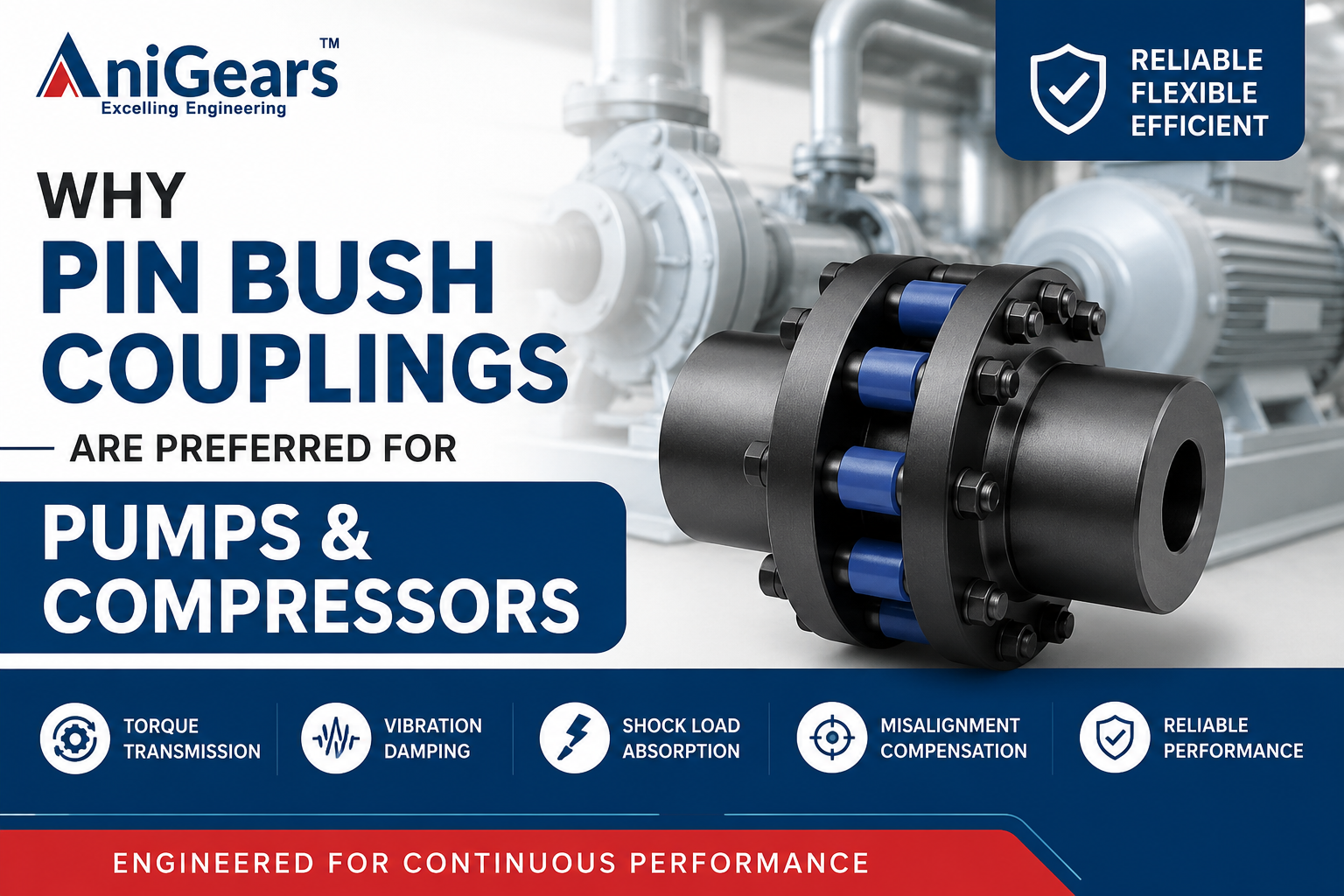
A standard pin bush coupling consists of two flanged hubs typically manufactured from high-grade cast iron to IS:210 Grade FG 200 or forged carbon steel connected through a set of precision-machined steel pins. Each pin carries a resilient rubber or polyurethane bush that fits within the corresponding hole in the opposing flange. Torque is transmitted from the driver flange through the pins, through the elastic bushes, and into the driven flange.
The elastic bush is the functional core of the assembly. Under torque, it compresses slightly, and this compression is the mechanism that provides both misalignment accommodation and vibration damping. The bush deflects to absorb shock loads during start-up and attenuates torsional vibrations during steady-state operation.
2.2 Misalignment Tolerance Quantified
A correctly selected and installed pin bush coupling can accommodate the following misalignment ranges simultaneously:
| Misalignment Type | Typical Tolerance (Small Sizes) | Typical Tolerance (Large Sizes) |
|---|---|---|
| Angular | Up to 1° | Up to 0.5° |
| Parallel (Radial) | 0.1 – 0.3 mm | 0.2 – 0.5 mm |
| Axial | ±1 – 2 mm | ±2 – 4 mm |
These tolerances are not large by comparison with gear couplings, but they are adequate for the dynamic misalignment that thermal expansion introduces in typical pump and compressor installations. They are also sufficient to provide bearing protection against residual alignment errors that are difficult to eliminate even with precision alignment tools.
2.3 Vibration Damping Coefficient
The elastic modulus of the rubber bush material provides measurable vibration attenuation. Natural rubber bushes offer a torsional stiffness in the range of 5,000 to 25,000 Nm/rad depending on coupling size, with damping coefficients typically between 0.05 and 0.15. This is sufficient to attenuate torsional resonance in most pump and compressor drive systems, preventing the build-up of vibration amplitudes that would otherwise damage motor bearings and cause shaft fatigue.
For compressor drives where torsional resonance is a genuine design concern, the coupling supplier should be consulted to confirm that the torsional natural frequency of the drive system does not coincide with the excitation frequency of the compressor.
2.4 Shock Load Absorption at Start-Up
During direct-on-line starting, the pin bush coupling's elastic element absorbs a portion of the starting torque spike before it reaches the driven machine. This is particularly valuable in applications where the compressor starts against backpressure or where the pump discharge check valve has not fully closed, creating a reverse-flow condition at start-up.
The service factor applied during coupling selection (typically 1.5 for steady loads to 3.0 for heavy shock) accounts for this by ensuring the coupling is sized to handle peak torques, not just mean operating torque.
2.5 Maintenance Without Machinery Movement
The rubber or polyurethane bushes in a pin bush coupling are the primary wear element. In most coupling sizes, these bushes can be replaced by sliding them off the pins after removing the coupling guard without requiring the motor or driven machine to be moved from their aligned positions. This is a significant operational advantage in process plants where re-alignment of large pumps or compressors is time-consuming and requires specialised tools.
3. Pin Bush Coupling Applications in Pump Systems
3.1 Centrifugal Pumps Water and Process Service
Centrifugal pumps driving water supply, cooling water circulation, and process fluid transfer represent the single largest application area for pin bush couplings in Indian industry. The combination of moderate torque levels, continuous duty, and the need for misalignment accommodation without lubrication makes the pin bush coupling the standard specification for these drives.
In water treatment plants operating 24 hours a day, the zero-lubrication maintenance requirement of the pin bush coupling is a practical operational benefit. In pharmaceutical and food-grade process plants, the absence of grease from the drive train eliminates a potential contamination vector.
3.2 Boiler Feed Pumps
Boiler feed pump drives operate at elevated temperatures, which generates predictable shaft misalignment as the pump casing and motor frame heat up during operation. The thermal growth of the pump is well understood and can be calculated, but even with calculated offset alignment at installation, the coupling must tolerate residual dynamic misalignment. Pin bush couplings specified with appropriate bush materials for the operating temperature range are routinely used on boiler feed pump drives up to several hundred kilowatts.
3.3 Fire Hydrant and Jockey Pumps
Fire pump systems are subject to infrequent but critical start-up demands. The coupling must be capable of transmitting the full starting torque of the motor without failure on every occasion which may be years apart during routine testing. The shock load absorption characteristic of the pin bush coupling, combined with its high reliability and long bush life under infrequent operation, makes it well suited to fire protection pump drives.
3.4 Reciprocating Compressors
Reciprocating compressors present a more demanding application. The pulsating torque output of a reciprocating compressor with peaks occurring at each compression stroke requires a coupling that can absorb torsional oscillations without transmitting them into the motor. A rigid coupling in this application would result in rapid bearing wear on both the motor and the compressor, and potentially shaft fatigue failure.
Pin bush couplings for reciprocating compressor drives are typically selected with polyurethane bushes rather than natural rubber, as polyurethane provides higher torque capacity and better resistance to the higher operating temperatures that compressor drives can generate. The torsional stiffness characteristics of the selected coupling should be reviewed against the torsional natural frequency of the compressor-motor system to confirm resonance is avoided.
3.5 Screw Compressors and Blowers
Screw compressors and rotary blowers operate at higher speeds than reciprocating machines and generate lower amplitude torsional pulsations at correspondingly higher frequencies. The primary coupling requirement in these applications is accurate balance (to avoid amplifying rotor vibration) and misalignment accommodation (since screw compressors are sensitive to bearing loads induced by coupling forces).
Pin bush couplings to IS:9975 or equivalent international standards are manufactured with closer tolerances on flange face runout and hub bore eccentricity for these applications, and are dynamically balanced when required.
4. Selection Parameters How to Specify the Correct Coupling
Selecting a pin bush coupling for a pump or compressor drive requires more than matching the shaft bore diameter. The following parameters must be established before a coupling size can be confirmed:
4.1 Design Torque Calculation
The design torque is not the rated motor torque. It is the rated torque multiplied by the service factor appropriate for the application:
Design Torque (Nm) = [9550 × Power (kW) / Speed (RPM)] × Service Factor
| Application Type | Typical Service Factor | Bush Type Recommended |
|---|---|---|
| Centrifugal pump, steady load | 1.25 – 1.5 | Natural Rubber |
| Centrifugal pump, variable speed VFD | 1.5 – 2.0 | Polyurethane |
| Reciprocating compressor, 2-cylinder | 2.5 – 3.0 | Polyurethane |
| Screw compressor / blower | 1.5 – 2.0 | Polyurethane or NBR |
| Boiler feed pump | 1.5 – 2.0 | NBR (oil/heat resistant) |
4.2 Shaft Bore and Keyway Requirements
Both shaft diameters driver and driven must be within the bore range of the selected coupling size. For mismatched shaft diameters, different bore sizes can be machined in each hub, but both must remain within the coupling's standard bore range. Keyway dimensions must conform to IS:2048 standards and match the shaft keyway specifications.
4.3 Environmental Conditions and Bush Material
The operating environment determines the appropriate bush material:
- Natural Rubber: General industrial environments, ambient temperature range −20°C to +70°C, no significant oil or chemical exposure.
- Nitrile (NBR): Applications where the coupling is exposed to oil mist, hydraulic fluid, or elevated temperatures up to +100°C. Standard for pump rooms handling petroleum products.
- Polyurethane: Higher torque capacity, superior abrasion resistance, and better performance in temperatures up to +80°C. Preferred for compressor and VFD-driven pump applications.
4.4 Speed and Dynamic Balance
At peripheral speeds above 20 m/s, pin bush couplings should be dynamically balanced to G6.3 standard as a minimum (to IS:5791 / ISO 1940). Unbalanced couplings at high speed generate centrifugal forces that are transmitted into motor and pump bearings, significantly reducing bearing life. For critical high-speed compressor drives, G2.5 balance grades should be specified.
5. Installation Requirements for Reliable Operation
The majority of premature coupling failures in pump and compressor drives trace back to installation errors rather than coupling deficiencies. The following installation requirements must be followed without exception:
5.1 Shaft Alignment
Initial alignment must be carried out with a laser alignment system or precision dial gauges. As a minimum, residual misalignment after alignment should be within 50% of the coupling's rated tolerance not at the maximum tolerance limit. This margin accommodates dynamic misalignment from thermal growth during operation.
For high-value process pump installations, laser alignment is strongly recommended. The additional time investment in achieving precise alignment is recovered many times over through extended bearing and coupling life.
5.2 Hub Fitting and Interference
Hubs should be fitted to shafts with a light interference fit (H7/k6 or H7/n6 depending on coupling size and application). A loose hub will fretting-corrode the shaft and generate false bole wear signals. Hubs are best fitted by heating to 80°C–100°C in an oil bath or using an induction heater cold press fitting risks damaging the bore surface.
5.3 Axial Gap (DBSE)
The distance between shaft ends must correspond to the coupling manufacturer's recommended DBSE. Too small a gap causes axial thrust forces as the shafts expand thermally; too large a gap reduces pin engagement in the bush and increases the bending moment on the pins. Both conditions reduce coupling service life.
5.4 Coupling Guard
A coupling guard is mandatory for all rotating equipment. For pin bush couplings, the guard should be sized to allow visual inspection of the coupling through an inspection window or removable panel without removing the guard. The early signs of bush wear fine black rubber dust visible at the base of the guard can then be detected without a shutdown.
6. Maintenance Schedule and Service Life Indicators
Pin bush couplings have no lubrication requirement, which eliminates one category of maintenance task. The maintenance regime focuses on periodic inspection and timely bush replacement before secondary damage occurs to the pins or flanges.
| Inspection Interval | Inspection Action | What to Look For |
|---|---|---|
| Every 3 months | Visual, external | Black rubber dust in coupling guard — first sign of bush wear |
| Every 6 months | Bush hardness and surface check | Surface cracking, hardening, or glazing of bush surface |
| Annually | Full disassembly inspection | Bush wear depth, pin surface condition, flange bore wear |
| At each major overhaul | Re-alignment verification | Confirm alignment meets specification; replace bushes as standard practice |
Bush Replacement When and How
Bushes should be replaced when wear depth exceeds 15–20% of original wall thickness, or when surface cracking is visible. Do not allow bushes to wear through to metal-on-metal contact. Once a pin begins making contact with the flange hole directly, the flange holes elongate rapidly and the entire coupling requires replacement rather than just the bushes.
Bush replacement procedure: remove the coupling guard, unbolt and remove one flange half, slide the worn bushes off the pins, fit new bushes of the correct material and size, reassemble, re-verify alignment, and replace the coupling guard. In most coupling sizes this can be completed within two to four hours without moving either machine.
7. Comparing Pin Bush Coupling to Alternatives for Pump and Compressor Drives
| Parameter | Pin Bush Coupling | Gear Coupling | Tyre Coupling | Grid Coupling |
|---|---|---|---|---|
| Misalignment tolerance | Moderate | High | High | Moderate |
| Vibration damping | Good | Poor | Excellent | Good |
| Lubrication required | None | Yes (grease) | None | Yes (grease) |
| Bush/element replaceability | Easy, in-situ | Not applicable | Easy, in-situ | Moderate |
| Torque capacity | Moderate | Very High | Moderate | High |
| Unit cost | Low | High | Moderate | High |
| Suitability – pump drives | Excellent | Good (large drives) | Good | Good (large drives) |
| Suitability – reciprocating compressor | Good | Poor | Excellent | Good |
For the majority of centrifugal pump drives below 200 kW and compressor drives below 150 kW, the pin bush coupling offers the best combination of cost, reliability, and maintenance simplicity. For higher-power or high-torque pulsation compressor drives, the tyre coupling's superior vibration damping may justify its higher cost.
Frequently Asked Questions
Specify the Correct Coupling for Your Drive System
AniGears Engineering Solutions manufactures flexible pin bush couplings to IS:9975 standards, with NABL-certified material testing and ISO 9001:2015 quality assurance. Our couplings are supplied in bore sizes from 14 mm to 150 mm, in natural rubber, NBR, and polyurethane bush configurations.
For pump and compressor coupling selection assistance, provide your motor power (kW), operating speed (RPM), shaft diameters, application type, and operating environment. Our technical team will recommend the correct coupling size, bush material, and service factor for your specific drive system.
Explore the Flexible Pin Bush Coupling product range at anigears.com, or contact us at works@anigears.com to discuss your application.
Related products: Gear Couplings | Tyre Couplings